
In the second half of the 17th century, some Dutch artists were playing visual tricks on their viewers. Others invited deep contemplation. Samuel van Hoogstraten had been a pupil of Rembrandt in 1640s Amsterdam. His peepshow demonstrates his mastery of perspective, the technique for creating depth on a flat surface.
Carel Fabritius was also taught by Rembrandt. He too explored optical illusions. His View of Delft was originally meant to be seen mounted on a concave surface, correcting its distorted perspective. Two years after painting it, he died in the Delft gunpowder explosion. This event is commemorated in a picture in this room by Egbert van der Poel.
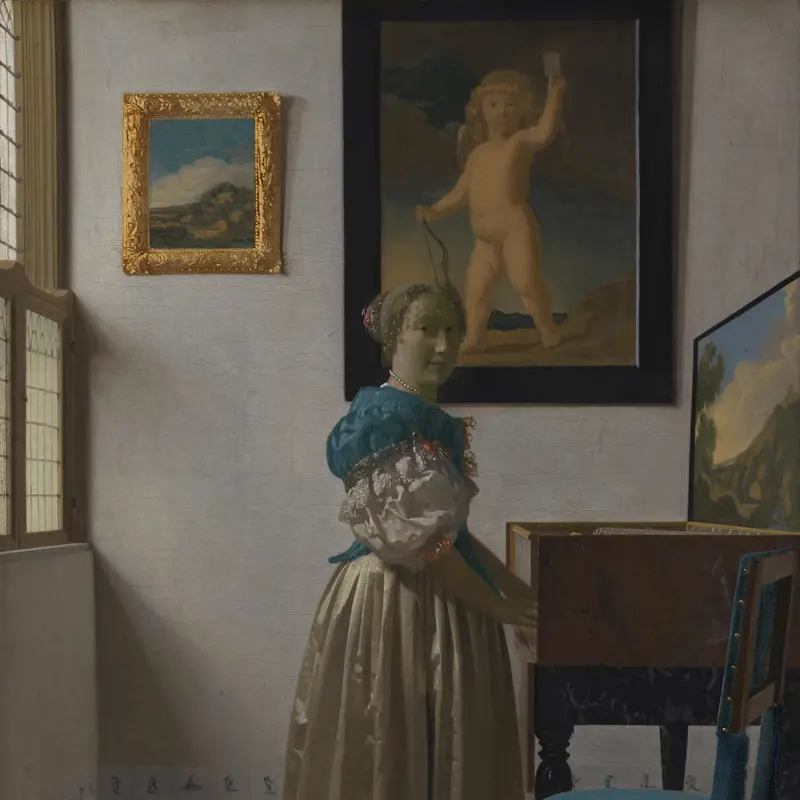
Another Delft-based artist, Johannes Vermeer, painted intimate scenes of everyday life. These are renowned for their treatment of light, colour harmonies and extraordinary attention to surface and texture. Vermeer transforms ordinary moments into meditations on stillness and perception. Through carefully structured compositions he creates an atmosphere of timeless quiet. Scenes of reading, writing or making music become images of poetic clarity and contemplative beauty. Such qualities are also found in the bright church interiors of Pieter Saenredam, whose works hang nearby.