
Crivelli was born in Venice and probably trained with Squarcione in Padua. He spent most of his life in the Marches (eastern central Italy), after periods in Venice and Zara. Crivelli was active as a painter by 1457 when he was condemned in Venice for adultery. He was very successful as a maker of altarpieces in the Marches. These are especially well represented in the Collection.
Crivelli was influenced by the Vivarini at an early stage. From Squarcione, or one of his pupils such as Giorgio Schiavone, Crivelli could learn simulated marble architecture; festoons of fruit; parchment cartellini and music-making putti. Venetian painting up to this point had been dominated by the Late Gothic style, such as that of Jacopo Bellini and his son Gentile.
Crivelli was a fine technical painter and his pictures are in a good state of preservation. He had a strong linear decorative sense and was a brilliant colourist. His work was particularly appreciated in the 19th century, as witnessed by the price paid for the Gallery's 'Madonna della Rondine'.
Carlo Crivelli
about 1430/5 - about 1494
Works by Carlo Crivelli
(Showing 6 of 25 works)

This large altarpiece was painted by Carlo Crivelli in 1491 for a family chapel in the Franciscan church in Matelica, a small town in the Italian Marches. The Ottoni were the local ruling family – you can see their coat of arms placed conspicuously on the bottom edge of the main panel.The locatio...
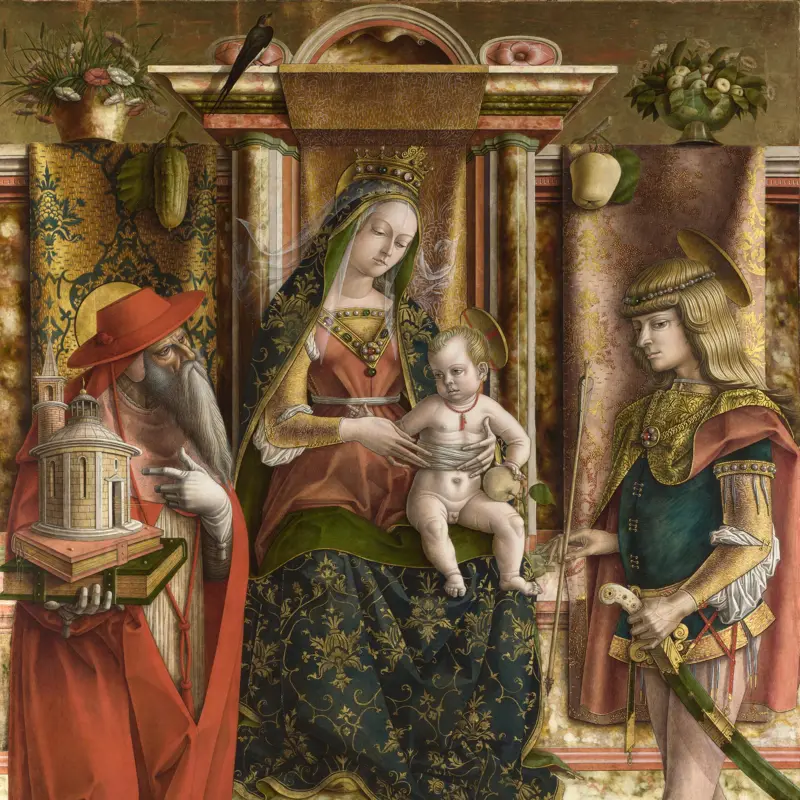
This large panel comes from an altarpiece painted in 1491 by Carlo Crivelli. It was made for the Ottoni family chapel in the Franciscan church at Matelica, in the Italian Marches.The Virgin, to whom the chapel was dedicated, appears crowned as the Queen of Heaven, with the Christ Child on her kne...
Not on display

This predella (literally ‘platform’ or ’step‘, the bottom tier of an altarpiece) comes from a large altarpiece that Crivelli painted for the Ottoni family chapel in the Franciscan church at Matelica, in the Italian Marches.The scenes reflect the patrons’ different interests – one was a churchman,...
Not on display
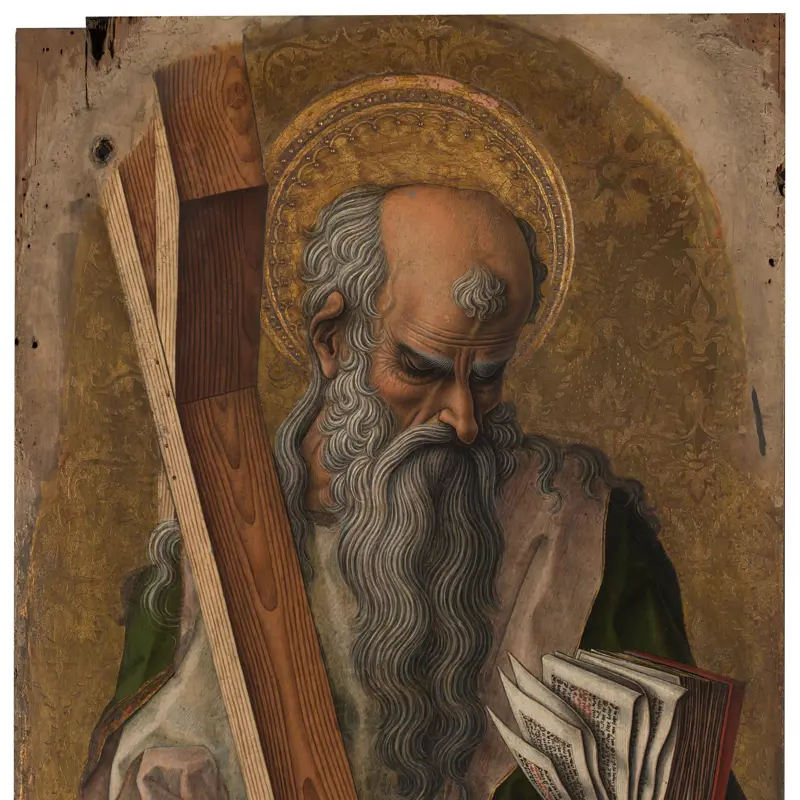
This bearded saint is one of four in the upper tier of a polyptych (a multi-panelled altarpiece) which Crivelli painted in 1476 for the high altar of the Dominican Church in Ascoli Piceno in the Italian Marche. He is Saint Andrew, the first Apostle, and a particular favourite of the Dominican Ord...
Not on display
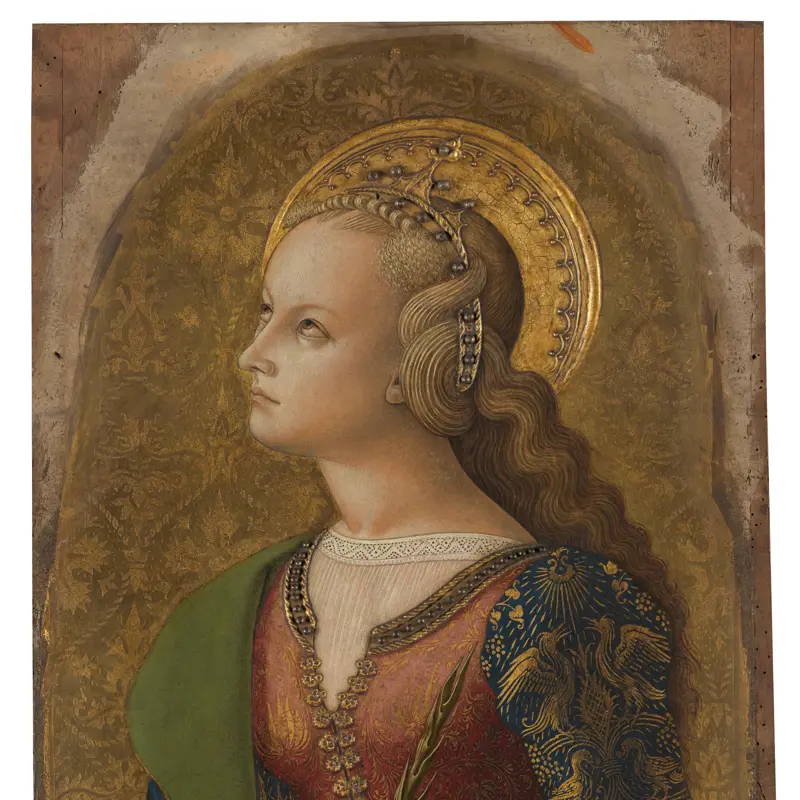
This graceful, golden-haired princess is Saint Catherine of Alexandria, identifiable by her traditional attributes of a spiked wheel and martyr’s palm. She comes from the great polyptych (multi-panelled altarpiece) which Crivelli painted for the church of the Dominican Order in Ascoli Piceno in t...
Not on display
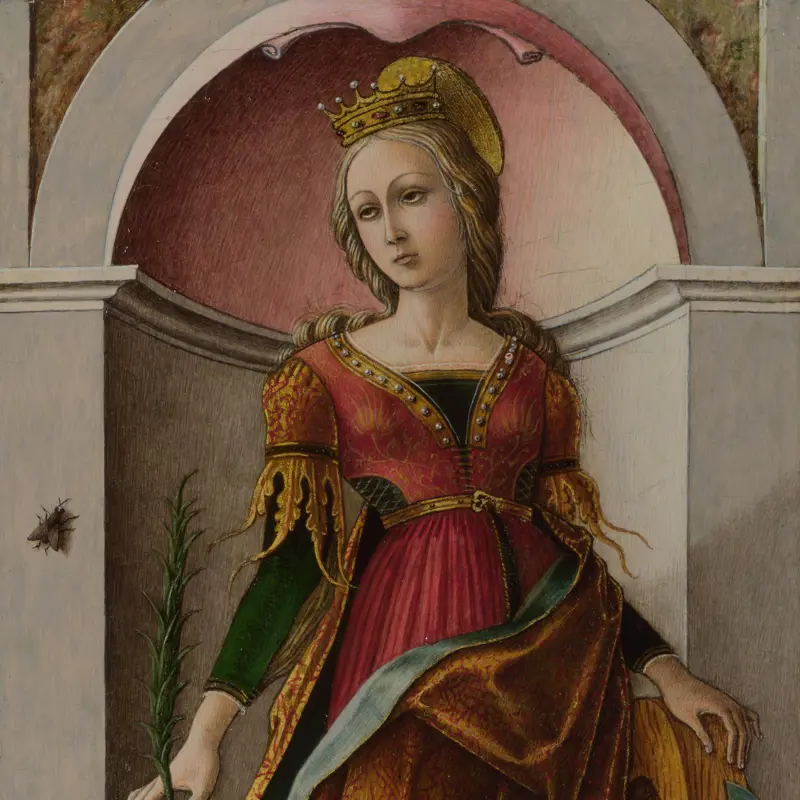
This graceful golden-haired princess comes from a predella, a row of scenes along the base of an altarpiece, or from the frame of an altarpiece. She is Saint Catherine, shown with her traditional attributes of a spiked wheel and a cactus-like martyr’s palm.To show off his skill with foreshortenin...
Not on display
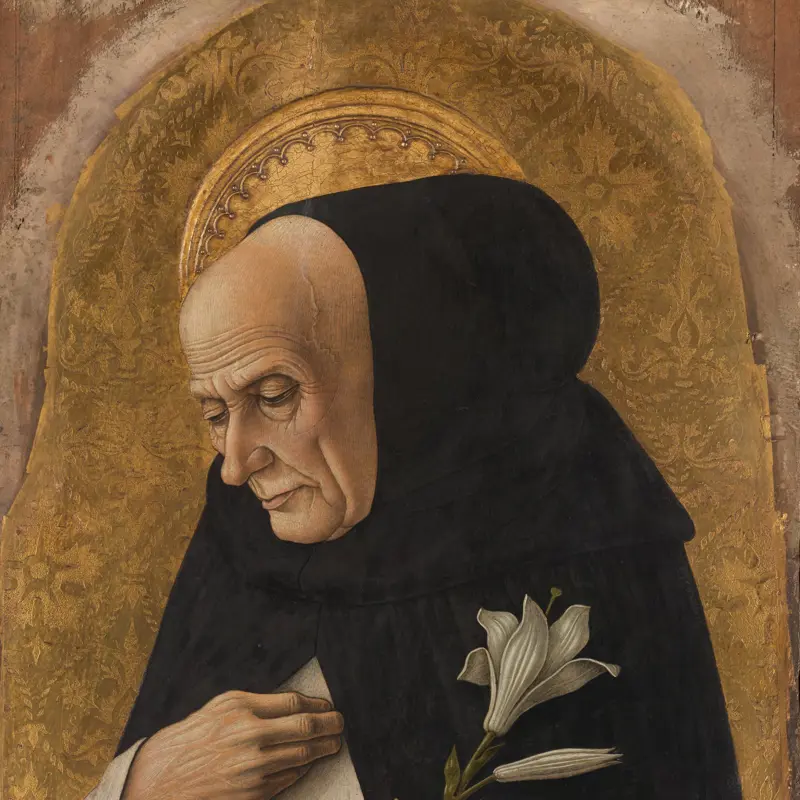
This saintly friar comes from a large polyptych (a many-panelled altarpiece) which Crivelli painted in 1476 for the high altar of church of San Domenico at Ascoli Piceno in the Italian Marche. This is Saint Dominic himself, holding a white lily to symbolise his chastity and the book of his Rule –...
Not on display
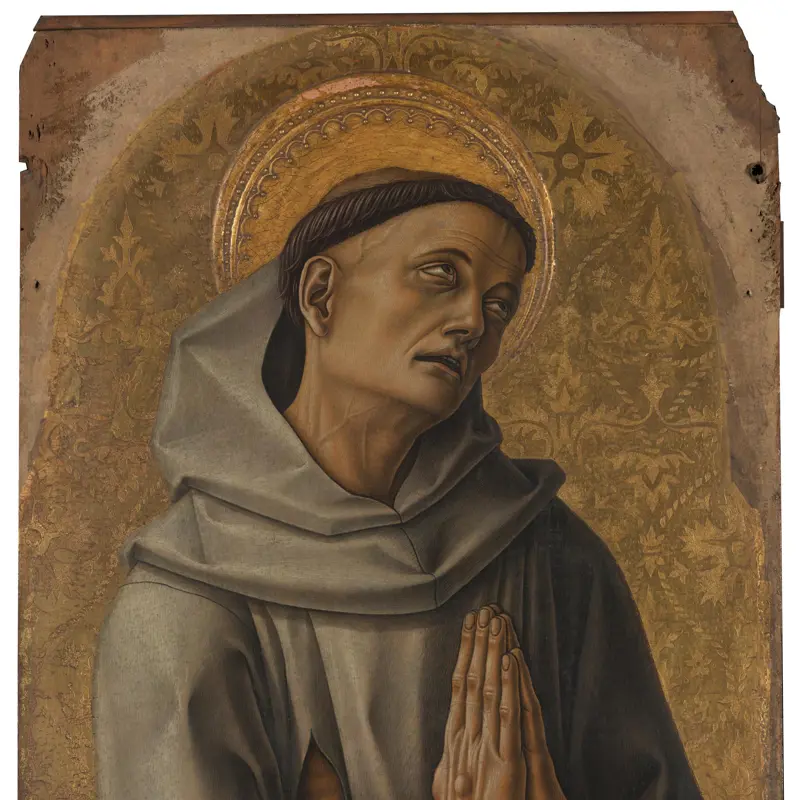
This praying saint comes from the upper tier of a large polyptych (multi-panelled altarpiece) which Crivelli painted in 1476 for the high altar of the church of San Domenico, in Ascoli Piceno in the Italian Marche. This is Saint Francis, founder of the Franciscan Order – friars who lived in towns...
Not on display
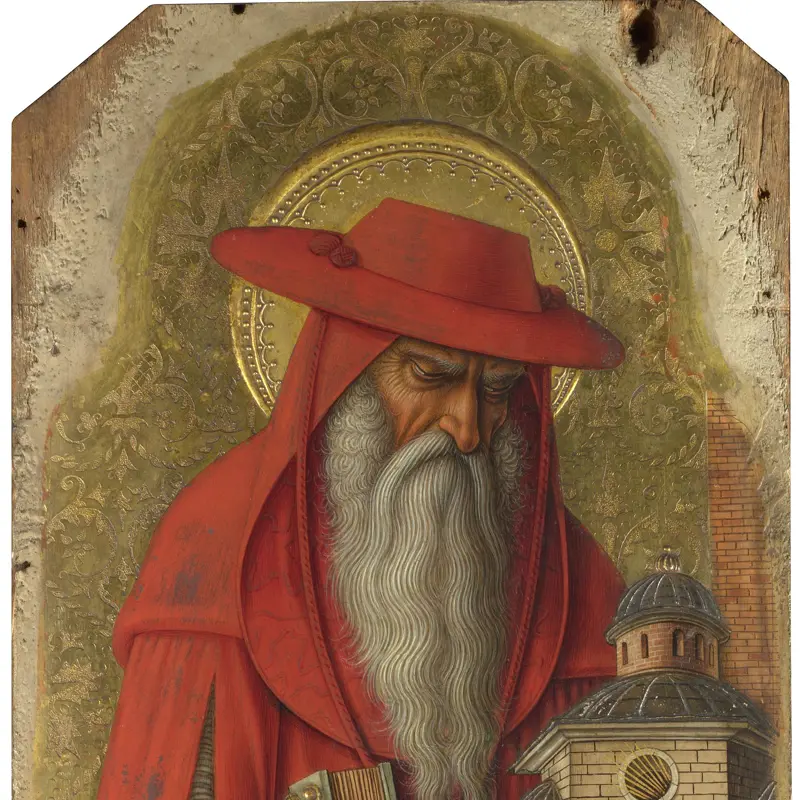
This bearded cardinal once stood at the left side of a small altarpiece that Crivelli painted for a side chapel in the church of San Domenico, in Ascoli Piceno in the Italian Marche. This is Saint Jerome, one of the Fathers of the Church and a favourite saint of the Dominican Order as a defender...
Not on display
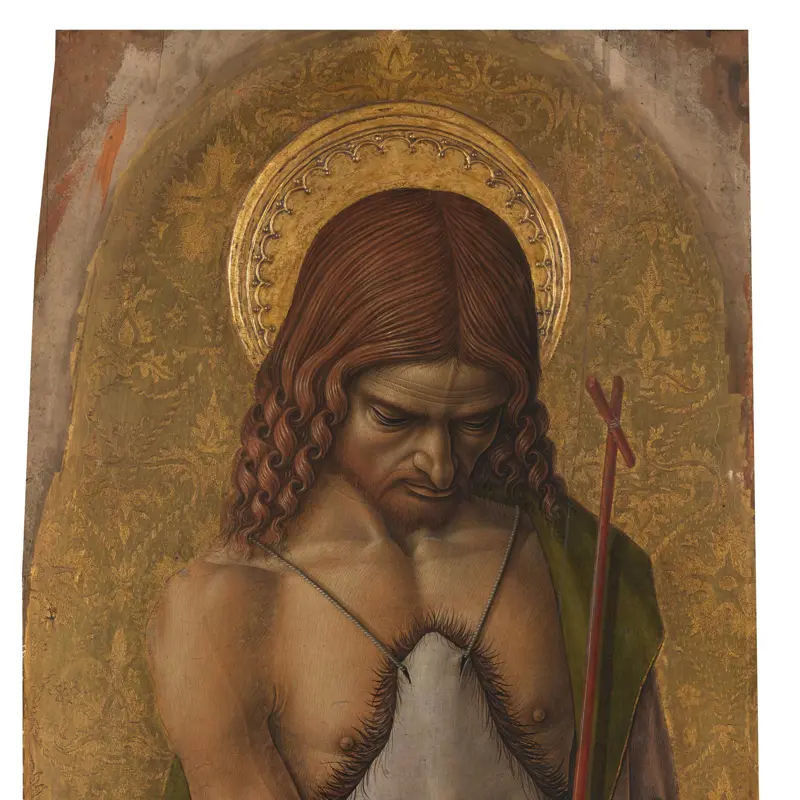
This striking half-naked figure is Saint John the Baptist. He comes from a large polyptych (multi-panelled altarpiece) which Crivelli painted in 1476 for the high altar of the church of San Domenico, in Ascoli Piceno in the Italian Marche. Crivelli’s attention to detail is such that we can see t...
Not on display
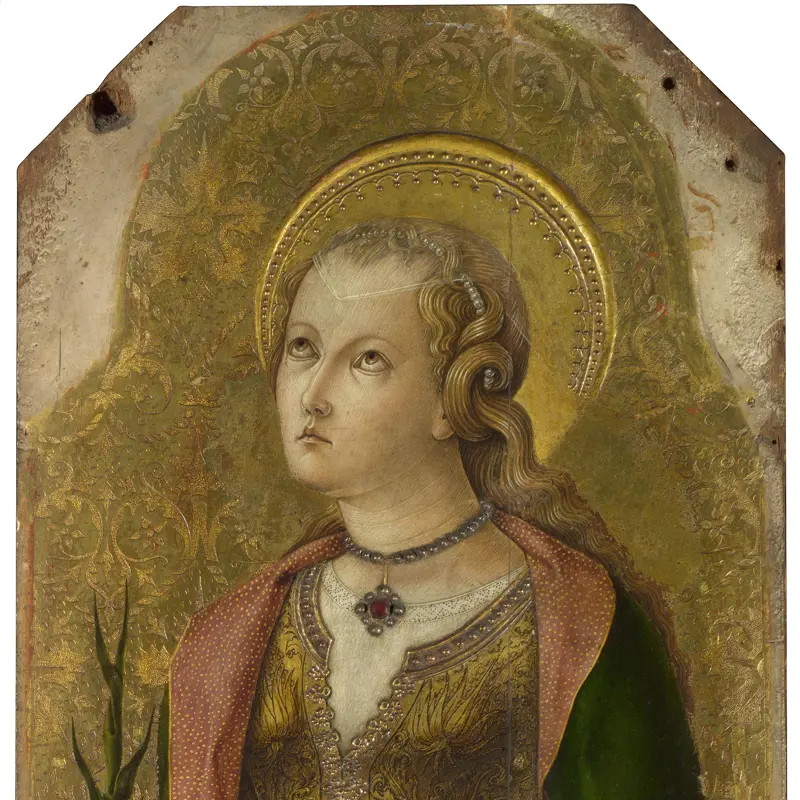
This elegant woman is Saint Lucy. She once stood on the Virgin’s left in a small altarpiece which Crivelli painted for a side chapel in the church of San Domenico, in Ascoli Piceno in the Italian Marche. Lucy holds her cactus-like martyr’s palm in one hand, and a circular wooden plate in the othe...
Not on display
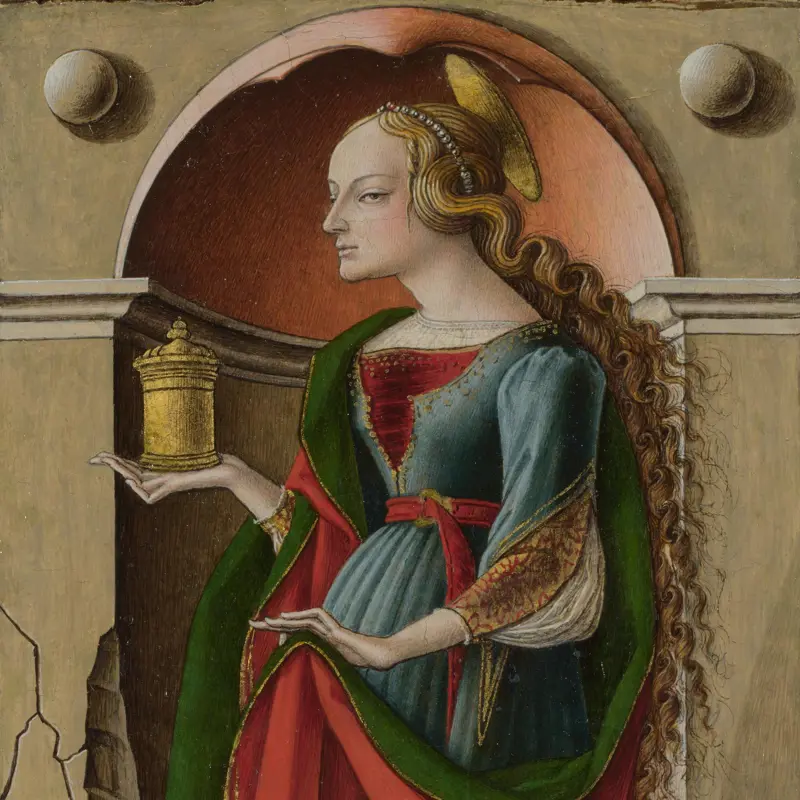
This elegant woman is Mary Magdalene, holding the pot of oil with which she anointed Christ’s feet. Although a biblical figure, she is dressed in the height of fifteenth-century fashion. Her red cloak and uncovered hair were meant to hint at the medieval understanding that she ‘gave herself to al...
Not on display
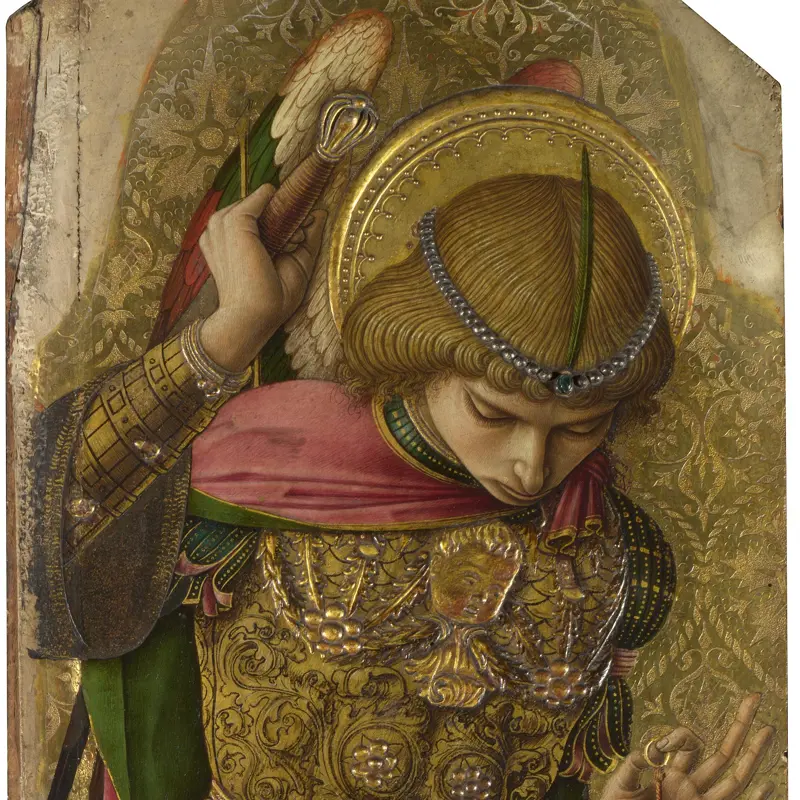
This panel of the Archangel Michael fighting the Devil was once part of an altarpiece painted by Crivelli for the church of San Domenico in Ascoli Piceno in the Italian Marche. Michael is shown as a youthful prince, his sword raised with nonchalant ease to strike the writhing devil beneath his fe...
Not on display
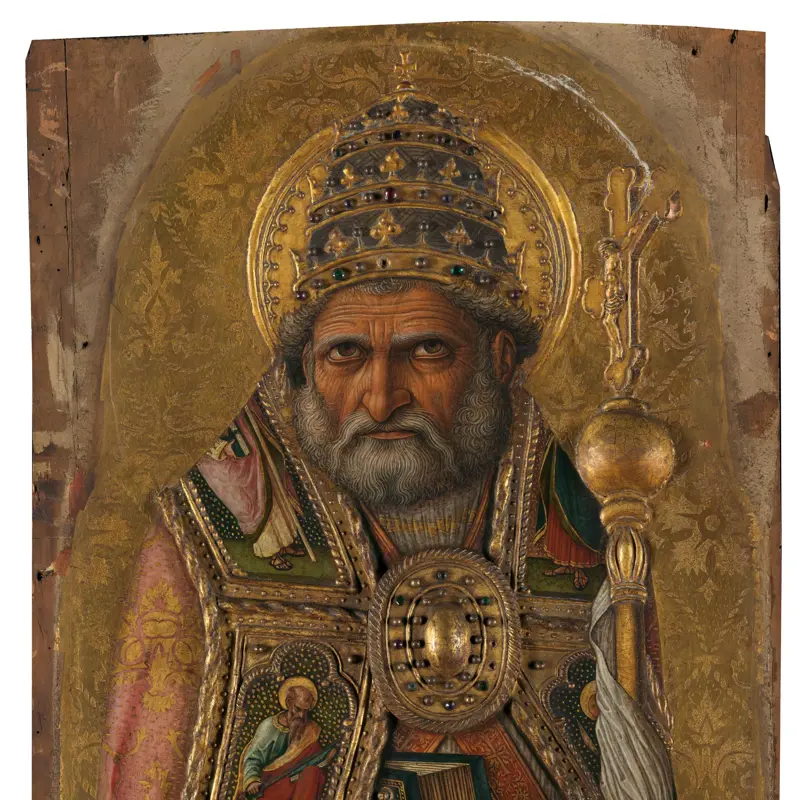
This stern and commanding figure is Saint Peter, the first pope and one of the founders of the Catholic Church. He comes from a polyptych (a multi-panelled altarpiece) which Crivelli painted for the high altar of the church of San Domenico, in Ascoli Piceno in the Italian Marche. His hooded eyes...
Not on display
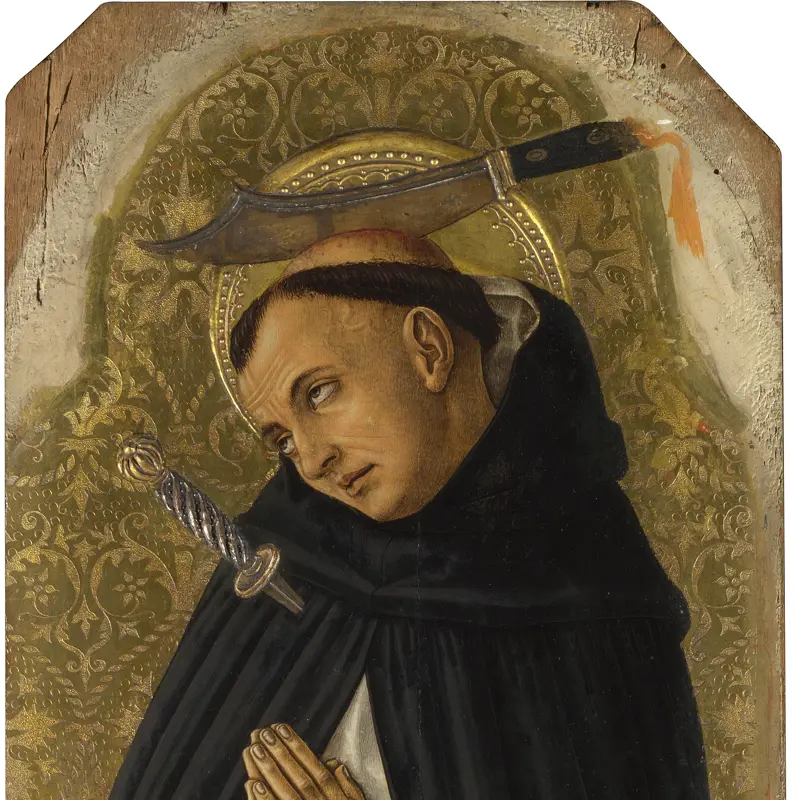
This priest – whose hair has been shaved, or tonsured – once stood on the right side of a small altarpiece which Crivelli painted for the church of San Domenico, in Ascoli Piceno, in the Italian Marche. He is Saint Peter Martyr, the second saint of the Dominican Order, and their first martyr.The...
Not on display
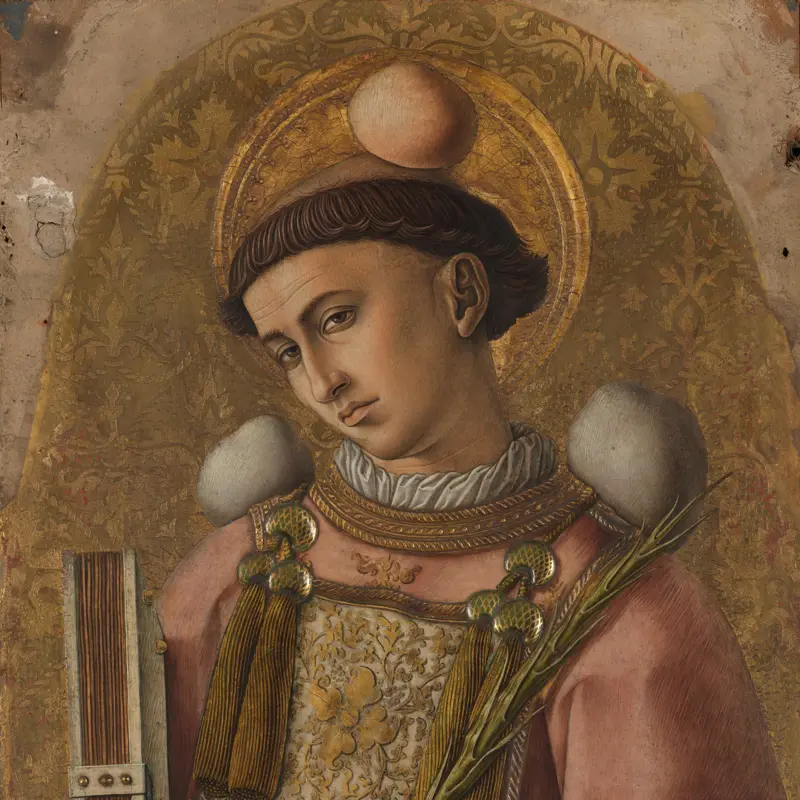
This half-length figure of a saint comes from a large polyptych (multi-panelled altarpiece) which Crivelli painted in 1476 for the high altar of the church of San Domenico, in Ascoli Piceno in the Italian Marche. This is Saint Stephen, Christianity’s first martyr.Potato-like rocks – representing...
Not on display
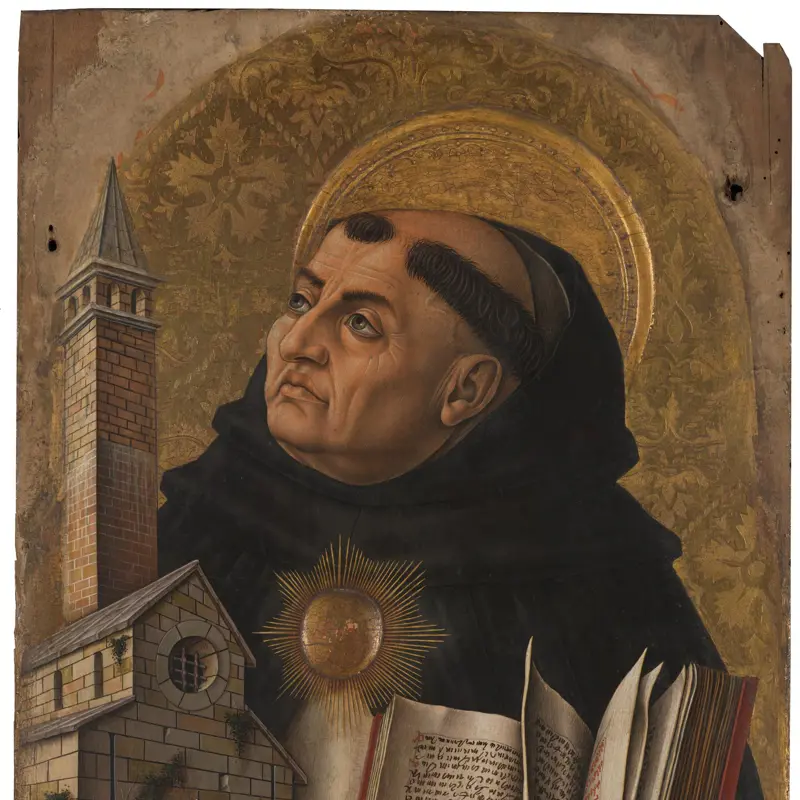
This half-length figure of a saint comes from the upper tier of a polyptych (multi-panelled altarpiece) which Crivelli painted in 1476 for the high altar of the church of San Domenico, in Ascoli Piceno in the Italian Marche. He is the theologian and Dominican friar Saint Thomas Aquinas (d. 1274)....
Not on display
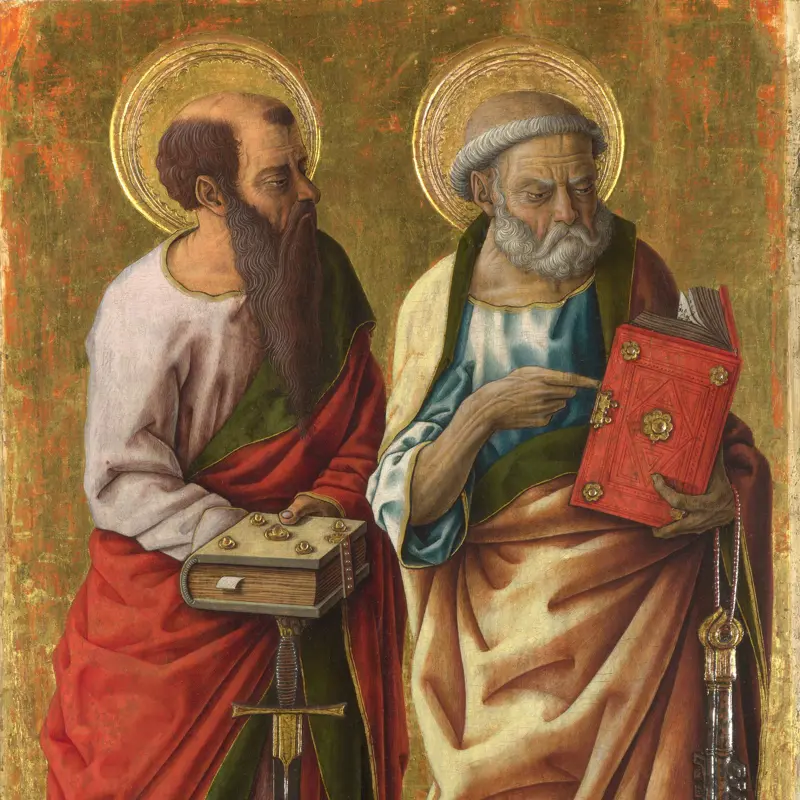
Two saints, Peter and Paul, are deep in conversation over an open book, one pointing out a particular passage to the other. This painting comes from a polyptych – an altarpiece made of a number of panels – painted for the high altar of parish church of Porto San Giorgio, the harbour of the city o...
Not on display
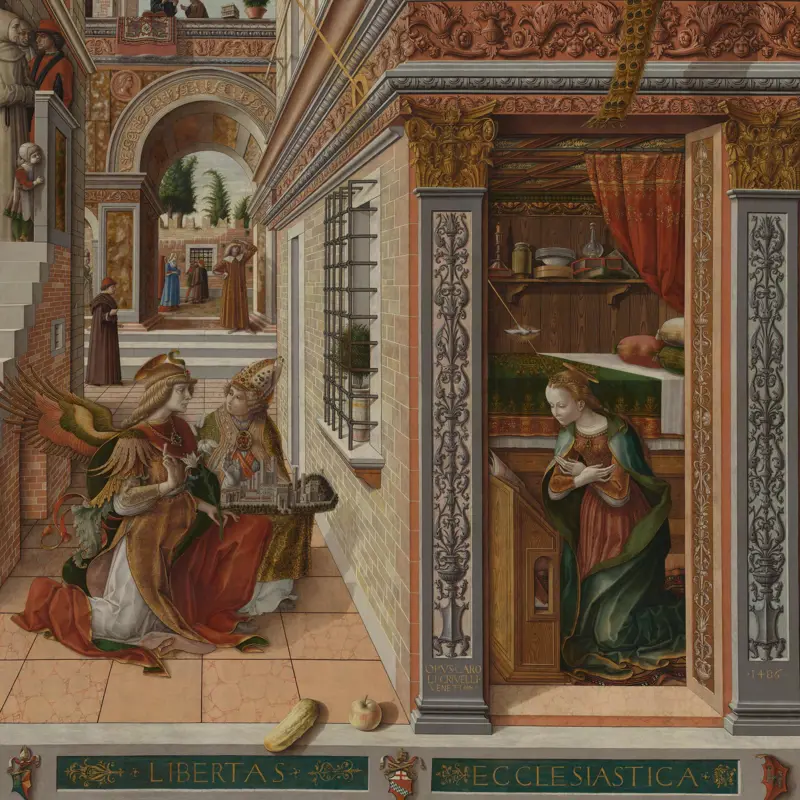
The Archangel Gabriel descends from God to tell the Virgin that she is to bear a child – a moment known as the Annunciation – but has been distracted from his mission by a bishop saint, who has stopped him in the street of a Renaissance town. This is Saint Emidius, patron saint of the town of Asc...
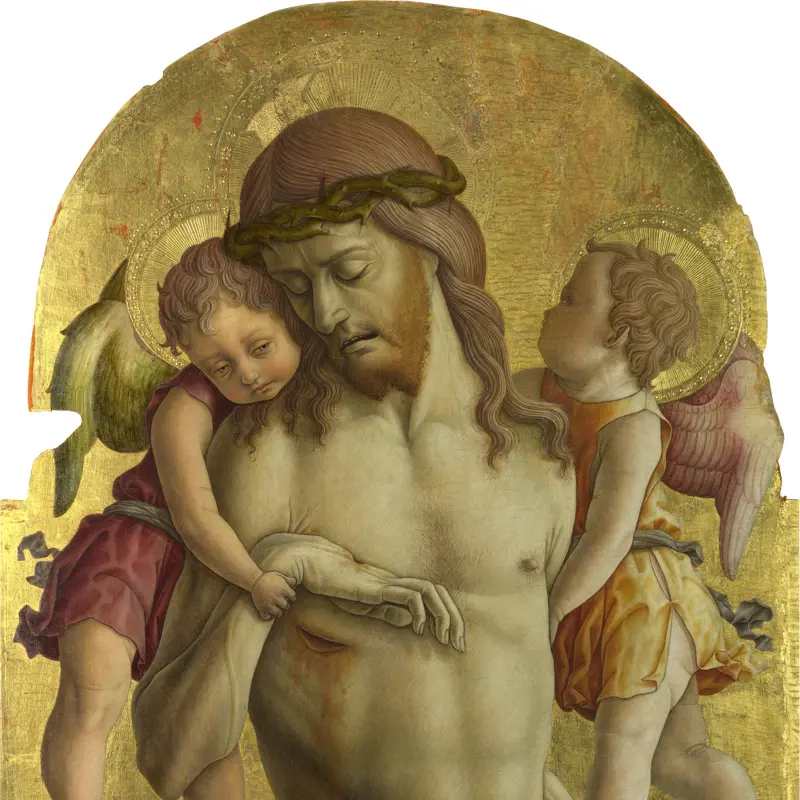
This arched panel was originally the top of a polyptych (a multi-panelled altarpiece) which Crivelli painted for the Franciscan church at Montefiore dell'Aso near Fermo in the Italian Marches.Two sad, child-like angels hold up Christ’s lifeless body, one nestling his head sorrowfully against Jesu...
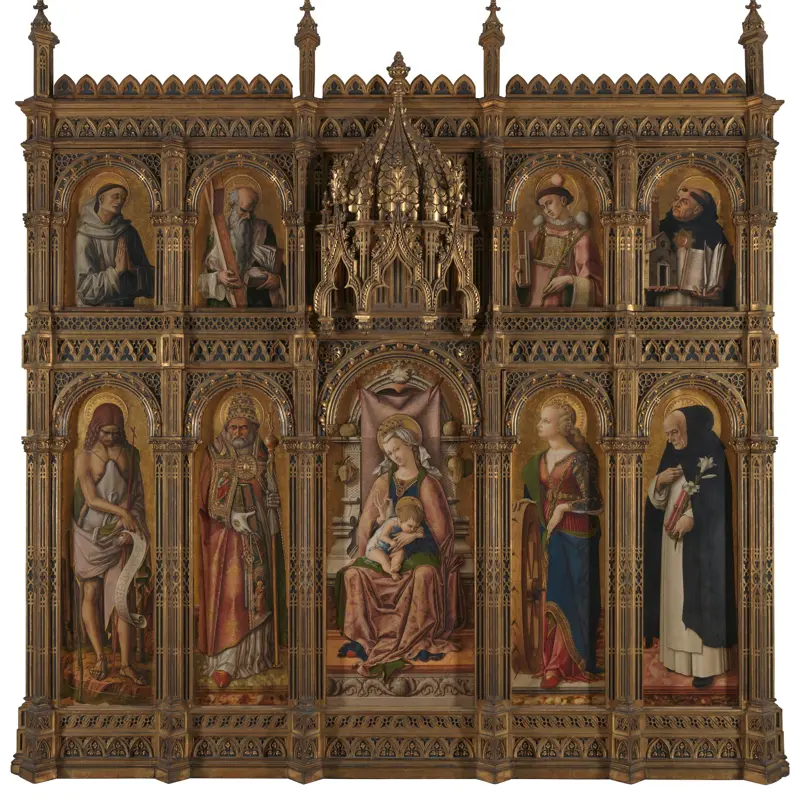
Crivelli painted two altarpieces for the small church of San Domenico, in the town of Ascoli Piceno in the Italian Marche. Their history is complex and intertwined. A large, double-tiered polyptych (a multi-panelled altarpiece) sat on the high altar, while a smaller altarpiece was in a side chape...
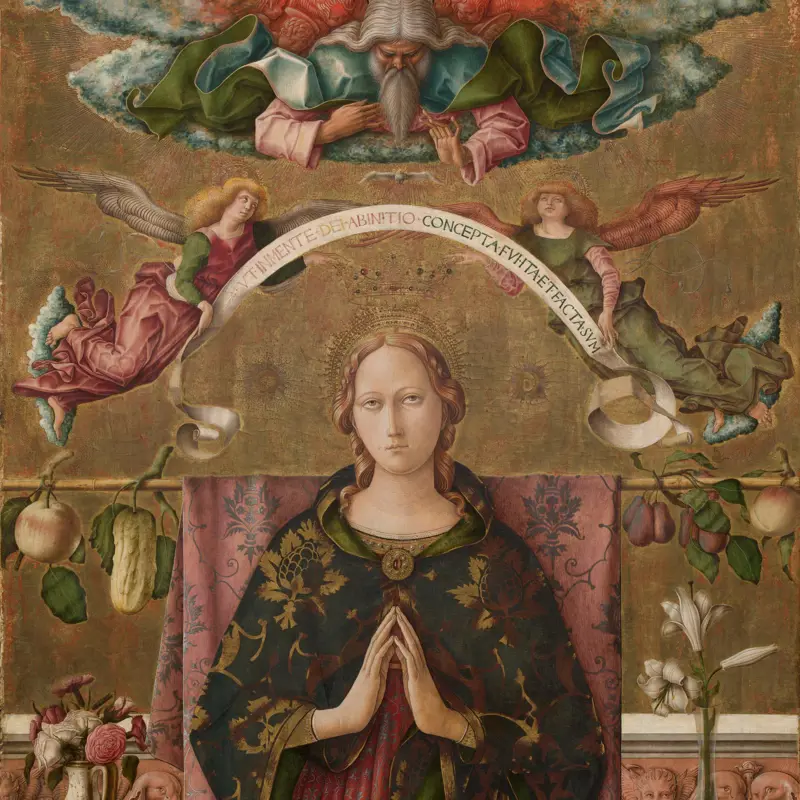
Crivelli painted this unusual image of the Virgin standing alone with no Christ Child for the church of San Francesco, Pergola, a little town in the north of the Italian Marche. The Virgin is depicted in a particular role, surrounded by symbols and texts that express the idea that she was conceiv...
Not on display
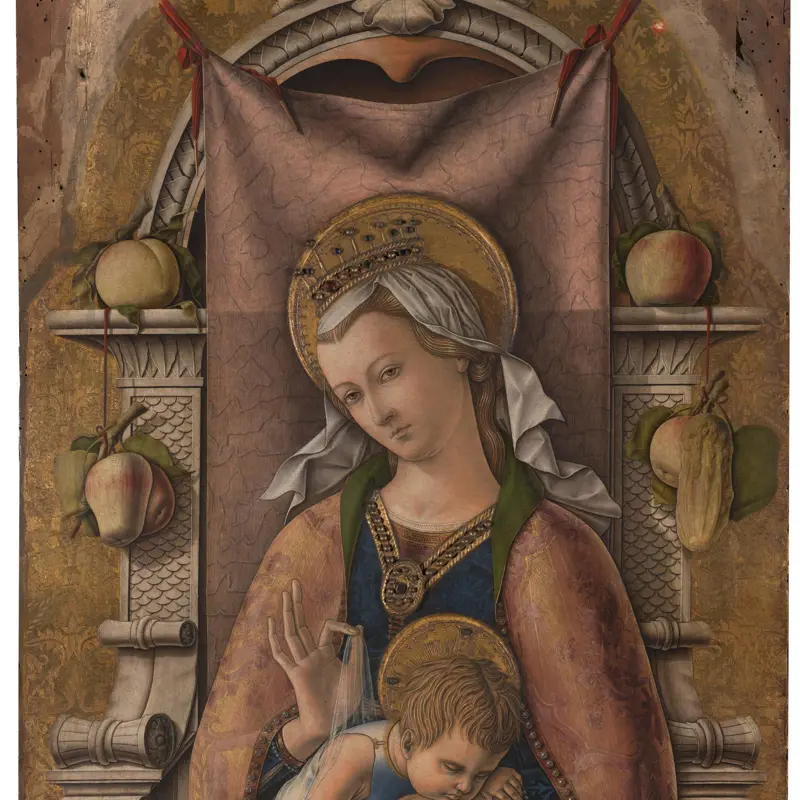
The Virgin, crowned and richly dressed as Queen of Heaven, sits on a marble throne. She comes from a polyptych (a multi-panelled altarpiece) which Crivelli painted in 1476 for the high altar of the church of San Domenico, in Ascoli Piceno in the Italian Marche. A pink watered silk – a cloth of ho...
Not on display
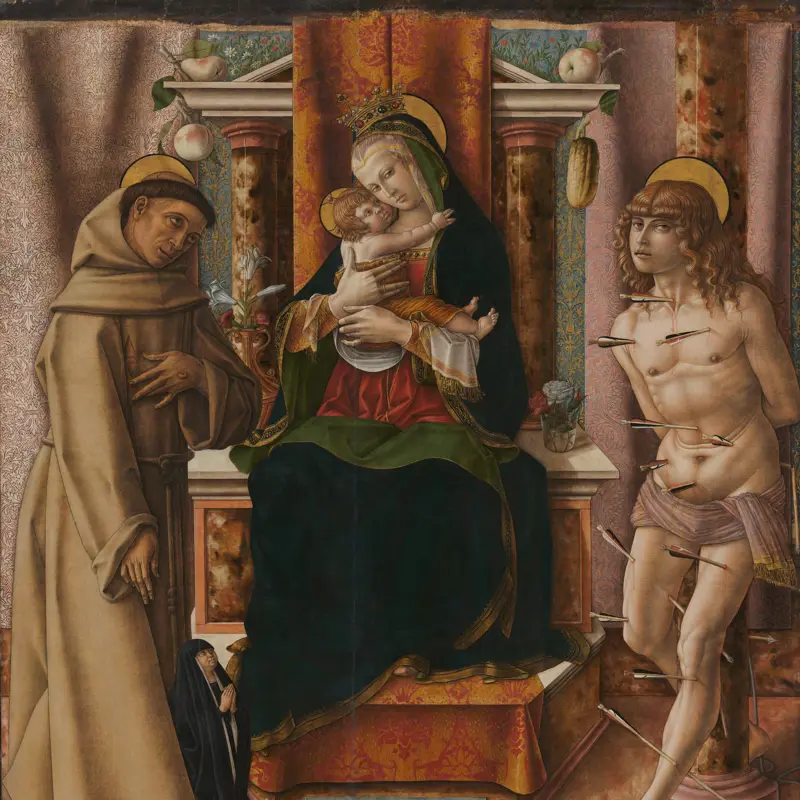
This painting, showing the Virgin and Child enthroned between Saints Francis and Sebastian, was the central panel of an altarpiece made for a family chapel in the Franciscan church at Fabriano, in the Italian Marches. At Francis’s foot, a stout little figure in widow’s dress is being presented to...
Not on display
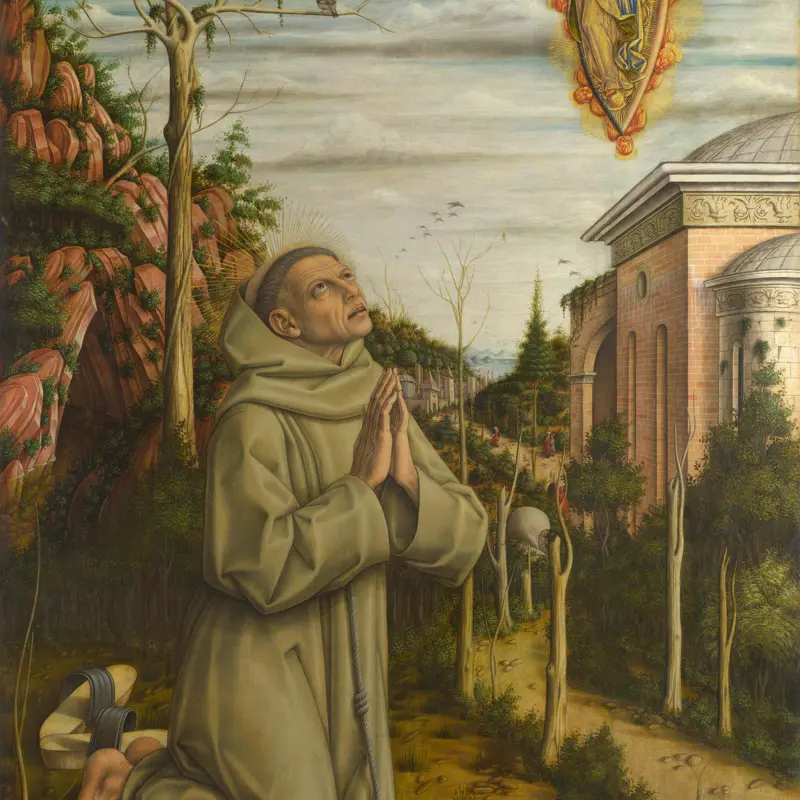
This tall, narrow panel once hung over the tomb of a Franciscan holy man, the Blessed Gabriele Ferretti (d. 1456). Gabriele was Superior of the small convent of San Francesco in Alto outside Ancona in the Italian Marche. He was famous locally for his fervent piety and for his visions of the Virgi...
You've viewed 6 of 25 works